Abstract
The adoption of blockchain technology, in a Regulated Accountability Network, faces challenges of privacy, scalability, and programmability. This document proposes a solution to these challenges using a Brazilian technology, ChainXS Blockchain, a fork of Bywise. By integrating technologies such as stealth addresses, uniform data distribution, chimeric ledger and parallel validation of transactions, the solution guarantees user privacy, can handle increasing volumes of transactions and can maintain high levels of performance without giving up auditability for regulatory bodies. These approaches balance the need for regulatory compliance with privacy protection, offering a robust and efficient infrastructure for the mass adoption of blockchain technologies.
Keywords Privacy, Blockchain, CBDC, Real Digital, RLN
Provenance of the numbers
This is the paper that carries the measured scalability figure for ChainXS. The table below separates what was observed at runtime from what is merely an architectural projection — the same provenance frame used on the home page.
-
Measured
1,000 TPS2024
ChainXS's scalability record reported in this paper. The proof of concept described in Section 6 reached 100 TPS on a laptop with a 6th-gen i7 (3.5 GHz) and 8 GB of RAM.
-
Theoretical
≈17 M TPS
Ceiling of the multiplicative slice structure, obtained from Equation 4 (≈ 1.79 × 10⁷ TPS); with the region regime, the paper's projection reaches more than 100 million TPS. These are architectural limits, never demonstrated.
1. Introduction
Permissioned blockchain brings benefits — enhanced security, transparency and programmability — but it also imposes challenges in privacy and scalability. According to Deloitte, 40% of companies have already implemented blockchains; the main challenges cited are the difficulty of deploying the infrastructure and the shortage of qualified professionals [4].
The Bitcoin whitepaper was published on 31 October 2008 [7]. It is an auditable system of payments between people without a financial institution, but with problems of privacy, scalability and programmability; it was the first cryptocurrency to create a legitimately decentralized asset.
Ethereum brought programmability with the EVM (Ethereum Virtual Machine), smart contracts and tokens [1]. Monero and Zcash (ZEC) brought anonymous transactions [10]. In 2015 the Hyperledger Project emerged, a multi-segment EVM-based blockchain [5].
In 2017 development of ChainXS began, a Brazilian open-source blockchain maintained by Devel Blockchain. Its initial proposal was a blockchain-based payments technology built on seven pillars — among them scalability, security, privacy and usability. It specialized in the corporate market and today is built from scratch, focused on being a security and data-management layer for enterprises. ChainXS makes it easy to create smart contracts using JavaScript and to integrate via REST API, lowering the barriers to entry.
2. Privacy
2.1 Distributed ledger
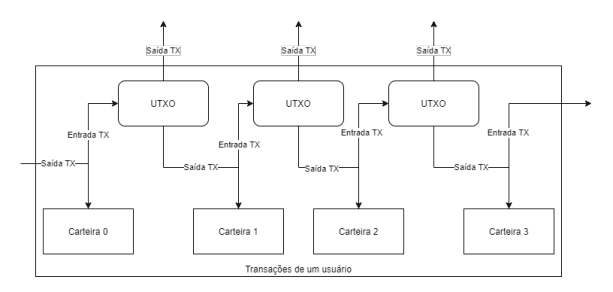
Any node can see all transactions, which guarantees auditability — but coupled with a loss of privacy. Linking a wallet to a real identity exposes balance and transactions. There are two major models: UTXO and account-based [13].
2.2 Account model
In permissioned EVM-based blockchains, privacy is even lower under the account model. Three drawbacks: (1) dependence between a transaction's result and the input state, hindering parallelism; (2) an incentive to reuse addresses, making it easier to link them to a single owner; (3) the volume of data needed to link a wallet to a single user.
2.3 Unspent Transaction Output — UTXO
In blockchains without much programmability, such as Monero, transactions are UTXO-based. Coins are stored as a list of unspent transaction outputs; each UTXO has an amount and a criterion for spending it. The model encourages generating a new address for each transaction received, which makes it hard to link coins to an owner. It is a model based on stealth addresses [12], more robust against leaks and attacks.
2.4 Privacy in Monero
Monero follows three principles: it encrypts the transacted values, uses stealth addresses, and shuffles senders using ring signatures drawn from other pending transactions. It respects the principles of non-traceability and disconnectability proposed by T. Okamoto and K. Ohta [8].
2.5 Privacy in ChainXS
ChainXS unites UTXO and programmability through the concept of the Chimeric Ledger [13], which allows stealth addresses and trivial parallel verification — thanks to the stateless nature of UTXO transactions. ChainXS does not encrypt the transacted values: it tries to reconcile auditing and privacy, keeping a public, open record of the data without exposing the true authors.
2.6 Comparison of privacy features
ChainXS is the only one to use the Chimeric Ledger transaction; it has advanced programmability (like Ethereum and Hyperledger) and privacy similar to Monero, but with auditability; it also works with stealth addresses.
| Blockchain | Transaction model | Programmability | Privacy | Auditability | Stealth addresses |
|---|---|---|---|---|---|
| Bitcoin | UTXO | Limited | Not allowed | Allowed | Optional |
| Ethereum | Account | Advanced | Not allowed | Allowed | Not allowed |
| Hyperledger | Account | Advanced | Not allowed | Allowed | Not allowed |
| Monero | UTXO | Limited | Allowed | Not allowed | Allowed |
| ChainXS | Chimeric | Advanced | Allowed | Allowed | Allowed |
3. Privacy in a Regulated Liability Network (RLN)
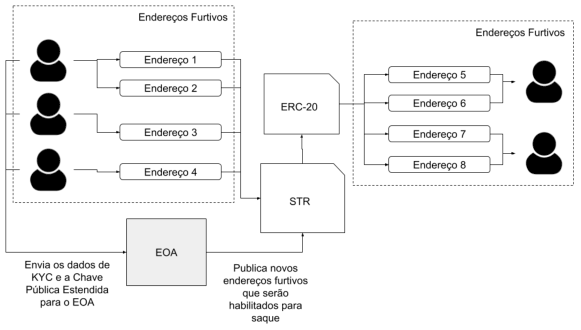
With the Real Digital pilot's system in mind, a system was designed with three main parts capable of using stealth addresses efficiently:
- Tokenized Real: the technical standard ERC20 (Ethereum Request for Comment — Standard Token) was used in compatibility with stealth addresses on the ChainXS chimeric network.
- STR contract (Sponsored Transaction Relayers): controls which stealth addresses are cleared to transact value.
- Enable Address Oracle (EAO): an oracle system that collects the KYC (Know Your Customer) together with a user's extended public key. When it detects a known address with a positive balance, it interacts with the STR contract, informing it of the new addresses cleared to transact.
3.1 Hierarchical deterministic wallets
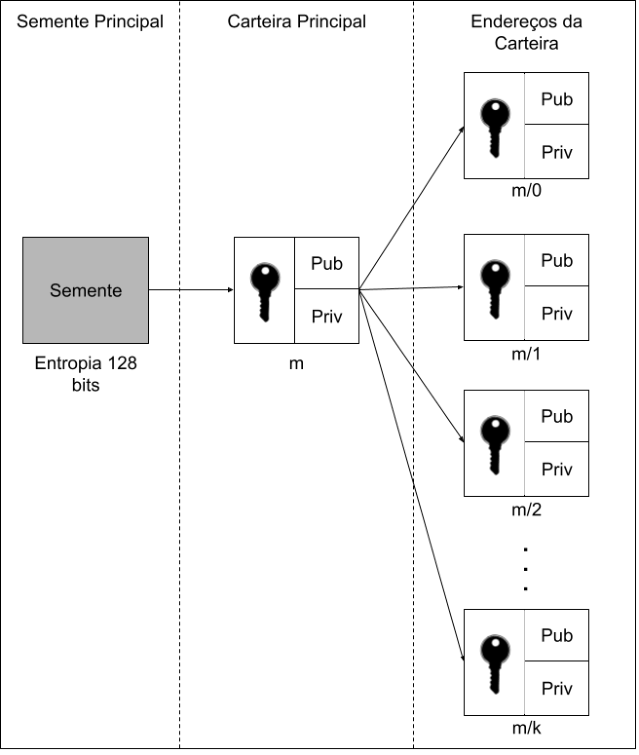
Introduced by the Bitcoin community [11], they have a tree structure, with each node holding an extended public and private key; any node can have any number of children. From a seed (a random number with 128 bits of entropy) the user's main wallet (m) is derived, which in turn derives the child keys (m/0, m/1, m/2, ..., m/k).
By sharing the extended public key with the oracle, once, the oracle cannot sign transactions on the user's behalf, but it will have access to the entire history. From one stealth address it is not possible to obtain the others. Thus only two entities have access to the history, the balance and the author: the user themselves and the oracle. The RLN architecture allows one or more oracles with the EAO function — financial agents, other institutions, the Central Bank and regulatory bodies can host oracles, creating a decentralized environment.
The benefits are: privacy; low confirmation time (a few seconds, like PIX, with funds held for the recipient for a short period — around a few minutes); auditability by authorized agents; and scalability, since each transaction can be verified trivially in parallel.
4. Scalability
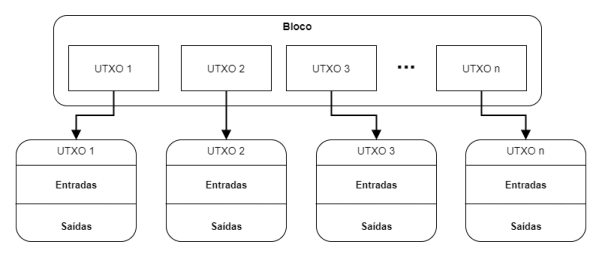
In a traditional blockchain, blocks are self-contained: transactions, hashes and signatures sit in a single package. A validator node assembles the block from a shared storage (mempool).
4.1 The limitations
Bitcoin produces a block roughly every 10 minutes, with up to 4000 transactions, reaching an approximate maximum of 6.67 transactions per second [9]:
Bitcoin Cash uses an 8 MB block and an average transaction of 480 bytes, reaching an approximate maximum rate of 56 TPS:
Fidelity note to the original: the paper's text cites "480 bytes" for the average transaction, but Equation 2, as printed in the PDF, uses the denominator 250. Both values are reproduced here exactly as in the original, without harmonization.
VISA processes 65,000 transactions per second (a reference). Proof of Stake and Proof of Authority raise security doubts, since they lack the massive experimental validation of Proof of Work. Solana (a PoS variant) uses a 400-millisecond block of up to 128 MB, with a theoretical maximum of 65,000 TPS; however it has already suffered outages, going unavailable for several hours due to propagation delay, which creates a risk of forking.
On forks, Christian Decker and Roger Wattenhofer modeled the probability of forks on the Bitcoin blockchain [3], related to block size and the average time between blocks. The only solution for large forks is intervention — parallel trees and their transactions vanish — with potentially large losses.
5. Block structure and propagation in ChainXS
One of the revised processes is full block validation before transmission (anti-spam), which creates delay and gives room for forks. ChainXS's strategy is to use the network's mempool to pre-process the transactions; the block hash serves as an identifier. If only the transaction hashes are stored (SHA-256, 32 bytes) and the block is 10 MB, one reaches 546.1 TPS:
That is a speed gain of almost 10× over Bitcoin Cash. ChainXS uses the Uniform Data Distribution (UDD) algorithm, formed of transactions and slices: the block is fragmented into small packages (slices) that carry the transaction hashes. A new mempool is added to hold the slices, also pre-validated.
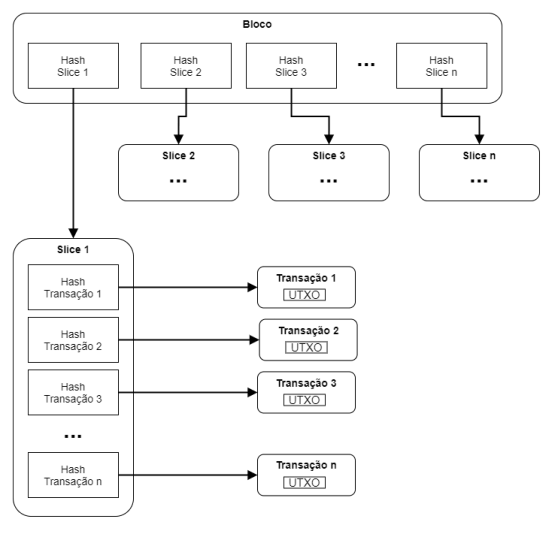
With this multiplicative structure — 1 MB slices and blocks of at most 10 MB — one gets an absurdly high value of almost 17 million transactions per second (the maximum count is quadratic):
With slices of 32,768 transactions (1 MB), one or two slices per block could occur at the start of the network — a vulnerability. To avoid too few slices, blocks were divided into regions.
| Region | Start | End | Transactions per slice |
|---|---|---|---|
| 1 | 0 | 100 | 10 |
| 2 | 100 | 1,000 | 100 |
| 3 | 1,000 | 10,000 | 1,000 |
| 4 | 10,000 | 100,000 | 10,000 |
| 5 | 100,000 | 600,000 | 100,000 |
The smaller slices are filled first. The number of transactions per block can exceed 60 billion — more than 100 million transactions per second.
5.1 Scalability through parallel processing
The propagation structure is similar to the Torrent protocol — fragmentation, validation and decentralized, parallelized distribution. Network limitations are practically eliminated, and processing becomes bounded by each node's computing power. Because of the nature of slices and the UTXO system, it is possible to parallelize; the TPS capacity grows as more validator nodes connect.
6. Proof of concept
A PoC was implemented to validate privacy and scalability, carried out on a low-powered laptop: a 6th-generation i7 at 3.5 GHz with 8 GB of RAM. Although ChainXS's theoretical capacity exceeds 1 million transactions per second, the scalability achieved in this PoC was 100 transactions per second — a value that can be increased with code optimizations and better hardware. On privacy, all objectives were met.
ChainXS's scalability record is 1,000 transactions per second, rising year over year.
For comparison: in 2023 PIX processed about 150 million transactions per day, or about 1,736 transactions per second on average [2]; peaks can exceed that average. The results indicate that ChainXS is viable for building an RLN.
7. Conclusion
Transparency and auditability are benefits inherent to the distributed ledger, but they frequently result in a loss of privacy for users. ChainXS Blockchain proposes an innovative solution by combining UTXO transactions with programmability, using the Chimeric Ledger and uniform data distribution — which allows parallel verification and increases scalability without sacrificing privacy. Hierarchical deterministic wallets in an RLN, together with validator agents, offer a robust structure for privacy and auditability: only the users themselves and authorized agents access the transaction history. It is a decentralized architecture that encourages use by many validators, guaranteeing auditability, security and a balance between privacy and transparency.
References
- Vitalik Buterin. Ethereum white paper: A next generation smart contract and decentralized application platform, 2013.
- Banco Central. Estatísticas do pix. https://www.bcb.gov.br/estabilidadefinanceira/estatisticaspix. Accessed May 2024.
- Christian Decker and Roger Wattenhofer. Information propagation in the bitcoin network. IEEE P2P 2013 Proceedings, 2013.
- Deloitte's. 2020 global blockchain survey. Accessed May 2024.
- Linux Foundation. Hyperledger whitepaper. https://blockchainlab.com/pdf/Hyperledger%20Whitepaper.pdf, 2015.
- Bitcoin Github. March 2013 chain fork post-mortem. https://github.com/bitcoin/bips/blob/master/bip-0050.mediawiki. Accessed October 2020.
- Satoshi Nakamoto. Bitcoin: A peer-to-peer electronic cash system, 2008.
- Tatsuaki Okamoto and Kazuo Ohta. Universal electronic cash, 1991.
- Erlend Solberg Thorsrud. Long-term bitcoin scalability. https://ntnuopen.ntnu.no/ntnu-xmlui/bitstream/handle/11250/2562793/19811_FULLTEXT.pdf, 2018.
- Nicolas van Saberhagen. Cryptonote v 2.0. https://cryptonote.org/whitepaper.pdf, 2013.
- Pieter Wuille. Hierarchical deterministic wallets. https://github.com/bitcoin/bips/blob/master/bip-0032.mediawiki. Accessed May 2024.
- Gary Yu. Blockchain stealth address schemes. Cryptology ePrint Archive, Paper 2020/548, 2020. https://eprint.iacr.org/2020/548.
- Joachim Zahnentferner. Chimeric ledgers: Translating and unifying utxo-based and account-based cryptocurrencies. Cryptology ePrint Archive, Paper 2018/262, 2018. https://eprint.iacr.org/2018/262.
Original document
Paper by Felipe Martins de Lima ([email protected]) and Henrique Gomes de Moura ([email protected]), affiliation ChainXS, 2024. Originally in Portuguese with an English abstract. This page is a faithful English rendering of the content; the primary source is the published PDF.
Read the original PDF (primary source) — whitepaper_chainxs.pdf
About the authors. Felipe Martins de Lima is an engineer and built the Bywise blockchain from scratch — open source under the MIT licence — of which ChainXS is a fork. Henrique Gomes de Moura is with the University of Brasília (UnB). This paper, from 2024, is the source of ChainXS's measured 1,000 TPS figure and the 100 TPS proof of concept on modest hardware.
The numbers presented here carry a provenance label: 1,000 TPS is a value measured at runtime; the ≈ 17 million TPS (and the projection of more than 100 million) are theoretical limits of the architecture, never demonstrated. The statements reproduce the original document without correcting any internal inconsistencies (see the fidelity note in Section 4.1).