Summary
Bywise is a third-generation cryptocurrency, built from scratch (not a fork) to make everyday use of cryptocurrencies viable. The project rests on seven pillars: scalability, safety, usability, governance, privacy, real-world applications and stability.
The technical core is the Uniform Data Distribution (UDD) architecture: a "superblock" made of slices that carry transaction hashes. Storing only transaction hashes (SHA-256, 32 bytes), a 10 MB block reaches 546.1 TPS — about 10× Bitcoin Cash. The multiplicative structure of 1 MB slices inside 10 MB blocks pushes the theoretical upper bound to almost 17 million TPS (quadratic growth), and the region regime (Table I) projects more than 100 million TPS — both architectural limits, never demonstrated. For a real-world provenance reference, the measured record of this technology family is 1,000 TPS (2024, ChainXS/RLN paper).
Keywords Bywise · blockchain · payment method · scalability · Uniform Data Distribution (UDD) · proof of work · instant payments · insurance nodes · stablecoin · CDP · oracles
Provenance note
This is a document of its time (~2021). Its editorial ruler on this site treats every number with a provenance label: what was measured, what is theoretical (an architectural, blackboard limit) and what was marketing. The whitepaper's high numbers — 17 million and 100 million TPS — are the upper ceiling of the UDD architecture, derived from formulas, and were never demonstrated on a network. The number actually measured and demonstrated for this technology family is 1,000 TPS, in the 2024 paper on ChainXS/RLN — see Privacy, scalability and programmability in an RLN.
-
Measured
1,000 TPS2024
Record demonstrated on a network, in the ChainXS/RLN paper with UnB. It's the number with empirical provenance — see the publication.
-
Theoretical
17 M TPS2021
Upper bound of the UDD architecture (Eq. 3.2), with a quadratic slice structure. A formula, not a measurement. The region regime (Table I) projects more than 100 million TPS, also theoretical.
-
Marketing
1,000,000 TPS2018
A forum promise predating the project, with no test. Recorded here only to complete the provenance line, consistent with the home page.
I. Introduction
On October 31, 2008 the Bitcoin whitepaper [12] was published. Until that time, there was no secure cryptocurrency without using a central institution. Bitcoin created an auditable system, without a central institution, and through proof of work (POW) made it more profitable for a malicious node to work in favor of the network than against it. Despite defects such as the lack of privacy, it was the first cryptocurrency to bring security and decentralization. This can be seen as the global race for the first cryptocurrency that managed to simulate the scarcity of an asset like gold in a scalable and reliable way [14].
Since 2009 several cryptocurrencies have specialized in niches: Ethereum (smart contracts, tokens) [2], Monero (anonymous transactions) [17], stablecoins like Tether and DAI (price based on a real asset such as the dollar or gold). Despite these efforts, no cryptocurrency is present in the population's daily transactions. Projects such as DASH, Zcash, Monero, Litecoin, BitcoinCash and BitcoinSV did not achieve a result comparable to a fiat asset. According to Mohania and Singh [11], there are differences between fiat and crypto, one of them being volatility.
Barriers that limit the use of crypto in retail:
- Currency volatility adds risk to asset usage.
- The high transfer rate between wallets makes its use less attractive.
- There is no guarantee of payment in the case of instant sales.
- High resistance from merchants and consumers; the crypto must be beneficial for both.
- Accessibility of the merchant and the consumer in using the asset.
- Low scalability, due to the delay for the blockchain to approve the transaction and the low number of transactions per second.
- Hacking risk and the cybersecurity knowledge required of users.
Just like 12 years ago, there is a race for the first cryptocurrency to enter the population's daily life; the path is gradual and possibly slow, but achievable as long as these barriers are broken in a single solution.
I.A Historic
- DASH: Digital Cash [5], intended as a means of payment in everyday transactions; positive usability (instant transactions), but based on the bitcoin architecture, which is not scalable and cannot be easily loaded onto a website without third-party services [9].
- Monero: specializes in anonymity; through a shuffling algorithm, transactions respect the non-traceability and disconnectability proposed by T. Okamoto and K. Ohta [13]. Part of its algorithm is based on bitcoin → scalability problems, despite variable parameters such as block size [10].
- Zcash: focused on optionally visible transactions; good for tax auditing and legal procedures (a key that only reads transactions [3]); as a fork of Bitcoin it has scalability problems, and the contingency plans fail at financing development.
- Other Altcoins: Bitcoin Cash (a direct fork increasing block size), BitcoinSV (a fork of Bitcoin Cash), Litecoin (the Bitcoin structure optimized for a higher transaction count). All carry the Bitcoin architecture's limitations: non-scalability, slow transactions, congestion and fee volatility.
I.B Governance
August 2017: one of the worst events in bitcoin's history, the hard fork that originated Bitcoin Cash [19]. The coin split into two chains; the price of BTC fell and then gave rise to the historic Bull Run. Fees passed 50 dollars per transaction. Origin: ideological differences among developers over increasing the block size from 1MB to 8MB, resolved immaturely. With a governance system, the decision could have been democratic. Tezos [8] is an example of good management, with a modular architecture and a voting system (no hard fork; friction is resolved by votes). Several groups exist (miners, investors, day traders, exchanges); there is a risk of one group taking control.
I.C A Bywise
Bywise intends to enable the use of cryptocurrencies in everyday transactions. It is part of the third generation of crypts and is not a fork of an existing project. It was built from scratch, based on seven pillars:
- Pillar 1 — Scalability
- Pillar 2 — Safety
- Pillar 3 — Usability
- Pillar 4 — Governance
- Pillar 5 — Privacy
- Pillar 6 — Real-world applications
- Pillar 7 — Stability
Validated by simulation. The innovations include the maximum rate of 100 million transactions per second without breaking the network into sidechains; a new secure instant-transaction system; a new block system; DeFi conversion to satellite stablecoins; multi-step security; and more accessibility to systems, shopkeepers and users.
II. The Block
Cryptocurrency blocks are packages filled with transactions. Transactions have inputs and outputs where the amount of input currency must equal the output, except when the creation of currencies for investors, developers and/or miners is foreseen. This structure forms a ledger showing the transaction history since the beginning of the network.
III. Block structure and propagation
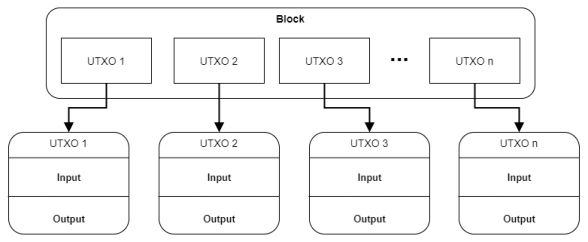
A node that wants to mine a block assembles it from a shared transaction storage (memPool), usually choosing the transactions that pay the best rates; nodes compete to find a hash smaller than a specific target; the winner spreads the valid block and takes the mining gains.
III.A The limitations
In Bitcoin, a block takes about 10 minutes and holds 4000 transactions → approximately 6.67 TPS [16].
In Bitcoin Cash, with an 8 MB block size and an average transaction size of 480 bytes → approximately 56 TPS.
Fidelity note to the original: the text states "480 bytes" as the average transaction size, but Equation 2.2 uses 250 in the denominator. Both values are reproduced exactly as in the original document, without correction.
VISA processes 65,000 TPS [18]. PoS (for example, EOS) is gaining popularity, but with many security doubts; it lacks the massive experimental validation that Bitcoin gave POW.
On forks: Decker and Wattenhofer modeled the probability of forks [4]; it relates to block size and the average time between blocks (tender time, in the original). 51% attacks are possible when the network divides. Stability and security make it impractical to change the block time or size much; increasing the speed 2–3× worsens propagation (a speed-vs-security trade-off).
Storing only the transaction hashes (SHA-256, 32 bytes), a 10 MB block reaches 546.1 TPS.
A speed gain of almost 10× over Bitcoin Cash. Bywise uses its own block architecture, Uniform Data Distribution (UDD), formed of transactions and slices — a "superblock" made of smaller block hashes (slices) that, in turn, carry transaction hashes. A new mempool is added for the slices, also pre-validated.
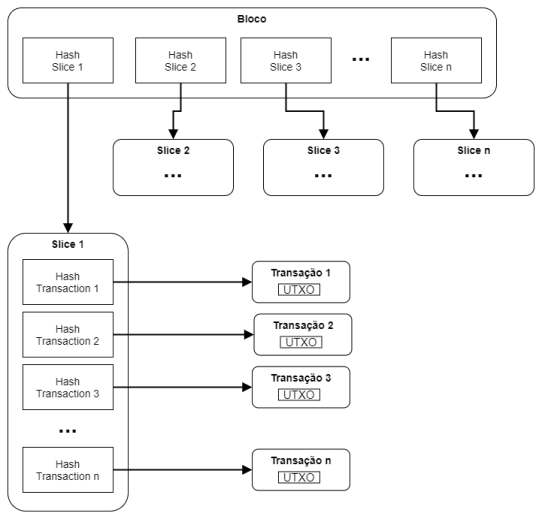
Multiplicative structure: 1 MB slices inside 10 MB blocks push the theoretical limit to almost 17 million TPS (quadratic growth).
These are slices of 32,768 transactions (1 MB); one or two slices per block at the start could open breaches for attacks → blocks are divided into regions.
| Region | Start | End | Transactions for each Slice |
|---|---|---|---|
| 1 | 0 | 100 | 10 |
| 2 | 100 | 1,000 | 100 |
| 3 | 1,000 | 10,000 | 1,000 |
| 4 | 10,000 | 100,000 | 10,000 |
| 5 | 100,000 | 600,000 | 100,000 |
The smaller slices are filled first; the number of transactions per block exceeds 60 billion in total and more than 100 million per second.
IV. Consensus
Bywise stratifies the block into slices and transactions → a new consensus algorithm. It is a variation of bitcoin's proof of work for block mining (which confers on it the security validated by bitcoin over the years). Transactions are validated before entering the mempool (no revalidation on block transmission). The slices are entirely new entities; using POW below the block level would risk collision and resource consumption.
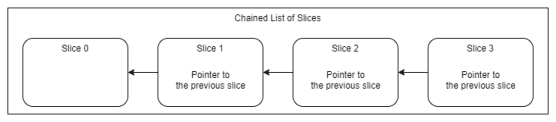
The slices are released freely by nodes that hold at least a defined amount of coins; they form a linked list in which each position points to the previous one.
- Rule 1: The first slice of the list will be the one that has the smallest difference between your hash and the hash of the previous block.
- Rule 2: Positions after the first will be defined by the smallest difference between your hash and the hash of the previous slice.
Each slice points to the previous one → it becomes economically unfeasible to forge blocks against the main list. The system is stratified; parts can migrate between POS and POW according to the governance system.
V. Instant payments
Instant payments already exist, but with purchase-security problems. Bywise uses insurance nodes responsible for insuring the purchase if it does not enter the blockchain. If the wallet has no balance and the insurance node signs by mistake, the amount is deducted from the insurance node's own funds.
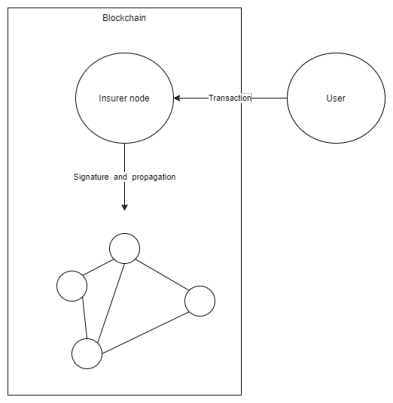
A wallet must define its insurance node for instant transactions; transactions are valid as soon as the node signs them (fast — with no dependence on blocks).
- Rule 1: The sum of transactions launched by an insurance node cannot exceed the balance of his wallet.
VI. Privacy
In bitcoin any node can see all transactions → auditing, but lost privacy (a wallet linked to a real identity loses balance and transaction privacy). Other cryptocurrencies allow complete anonymity but without audit permission → fraud cannot be detected; legal problems arise (schemes of corruption, trafficking, money laundering). To reconcile auditing and privacy, Bywise uses each wallet only once, so the user's balance is the sum of the balances of the wallets in use.
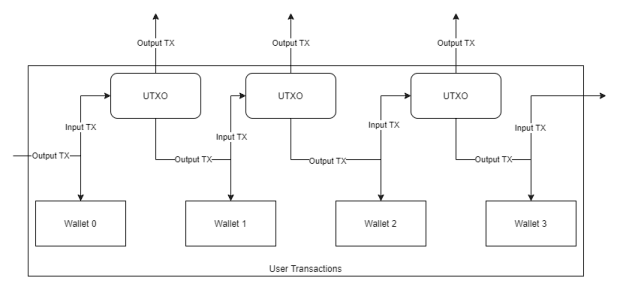
The network grows in a chaotic way; even if an identity is linked to a wallet, it is unlikely to trace it in the long term — and, even so, the system remains auditable and any fraud can be detected.
VII. Usability
Many cryptocurrencies fail for lack of usability. Old languages persist: according to W3 Techs, PHP is still used on 78.9% of sites [15]; Wordpress is used by at least 38.8% of the entire web. The problem: the low-level sockets used by practically all blockchains require VPNs / expensive tech / technicians. For greater usability, Bywise uses HTTP requests and websockets in most of its communications → plugins on all hosting/embedded systems without third parties (avoiding fees from services like Picpay or Paypal).
VIII. Governance
Lack of governance is a serious problem; the iconic example is the Bitcoin Cash hard fork. Tezos [8] is a differentiator (a modular architecture, a voting system within the blockchain). Bywise has a voting system within the blockchain in which the weight of the vote is based on the amount of Bywises a wallet holds, preventing a single group from dominating decisions.
IX. Stability
Every economy needs a minimally stable currency. Bywise implements a DeFi system within its blockchain for currency conversion, based on collateralized debt positions (CDPs) and oracle nodes. A user who wants stability saves resources as satellite tokens, with prices based on fiat currencies.
IX.A Collateralized Debt Positions (CDPs)
Introduced by DAI [6]; the MAKER platform issues smart contracts that exchange ERC20 tokens for DAI at a stable value of 1 DAI to one dollar.
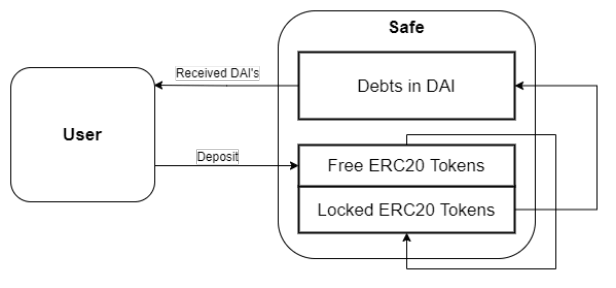
The CDPs function as a safe in which an ERC20 token is stored in exchange for DAIs; the funds do not leave the platform → auditable and reliable. The safe's creator gets a debt in exchange for the DAIs, locking assets; multiple debts are possible; each safe holds one type of ERC20 token.
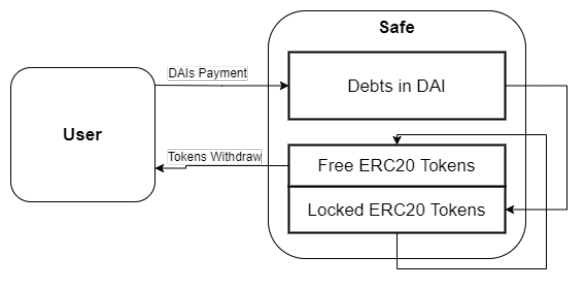
The debt is extinguished upon payment; a fund-withdrawal fee (the stability fee) controls the flow of DAIs and stabilizes the value toward the target (1 USD).
IX.B Oracles
The market price of each token is defined in real time through oracle nodes, democratically voted by the community to define the conversion value of each ERC20 token into dollars. An extra security layer: delaying the targets by 1 hour, so that it is possible to stop an attacker who takes control of the oracles.
IX.C Bywise
The CDPs and oracles regulate a token's price based on a fiat currency or an asset such as gold/silver. For each fiat currency there can be a corresponding token of the same price. A trader/broker can trade and store stable tokens while the user uses Bywise or any satellite token.
X. Energy efficiency
POW needs a lot of computing power. ASICs are the best at speed and energy efficiency: for example, the Antminer S19 Pro reaches 110 TH/s and has 4400 Watts of power, the equivalent of 25 GH/W. Even so, miners compete and difficulty tends to increase to fix the block time at 10 minutes [1]; POW networks are regulated, keeping energy expenditure almost constant. As Chapter III shows, Bywise processes many more transactions per block (plus slice-selection algorithms optimized for speed) → in the same 10-minute contest it processes a much higher volume, so the computational cost per transaction is much lower, increasing energy efficiency.
References
- Bitcoin.org. Bitcoin - block chain. https://developer.bitcoin.org/devguide/block_chain.html. Accessed October 2020.
- Vitalik Buterin. Ethereum white paper: A next generation smart contract and decentralized application platform, 2013.
- Electric Coin Co. Zcash basics. https://zcash.readthedocs.io/en/latest/rtd_pages/basics.html. Accessed October 2020.
- Christian Decker and Roger Wattenhofer. Information propagation in the bitcoin network. IEEE P2P 2013 Proceedings, 2013.
- Evan Duffield and Daniel Diaz. Dash whitepaper. https://github.com/dashpay/docs/raw/master/binary/Dash%20Whitepaper%20-%20V2.pdf, 2014.
- Maker Foundation. The maker protocol: Makerdao's multi-collateral dai (mcd) system. https://makerdao.com/pt-BR/whitepaper/. Accessed February 2021.
- Bitcoin Github. March 2013 chain fork post-mortem. https://github.com/bitcoin/bips/blob/master/bip-0050.mediawiki. Accessed October 2020.
- L.M Goodman. Tezos — a self-amending crypto-ledger white paper. https://tezos.com/static/white_paper-2dc8c02267a8fb86bd67a108199441bf.pdf. Accessed October 2020.
- Dash Core Group. Getting started - merchants. https://docs.dash.org/en/stable/merchants/getting-started.html. Accessed October 2020.
- Monero Research Lab. Monero scalability. https://www.getmonero.org/resources/moneropedia/scalability.html. Accessed October 2020.
- Dr. Sarvesh Mohania and Dr. Shriti Singh. An analysis of cryptocurrency and its challenges. EPRA International Journal of Multidisciplinary Research, pages 104–107, 4 2020.
- Satoshi Nakamoto. Bitcoin: A peer-to-peer electronic cash system, 2008.
- Tatsuaki Okamoto and Kazuo Ohta. Universal electronic cash. page 324–337, 1991.
- N. Popper. Digital Gold: Bitcoin and the Inside Story of the Misfits and Millionaires Trying to Reinvent Money. Harper Paperbacks, 2016.
- W3 Techs. Usage statistics of php for websites. https://w3techs.com/technologies/details/pl-php. Accessed October 2020.
- Erlend Solberg Thorsrud. Long-term bitcoin scalability. https://ntnuopen.ntnu.no/ntnu-xmlui/bitstream/handle/11250/2562793/19811_FULLTEXT.pdf, 2018.
- Nicolas van Saberhagen. Cryptonote v 2.0. https://cryptonote.org/whitepaper.pdf, 2013.
- VISA. Visanet: o poder de conectar o mundo. https://www.visa.com.br/.... Accessed October 2020.
- Nick Webb. A fork in the blockchain: Income tax and the bitcoin/bitcoin cash hard fork. https://scholarship.law.unc.edu/..., 2018. Accessed October 2020.
Languages
This page presents the original English whitepaper. A faithful Portuguese rendering is available at publicações › Bywise (português). Primary source: bywise.org/assets/whitepaper.pdf.
About this publication. The original Bywise whitepaper, written by Felipe Martins and Vitor Sulzbach (Devel Blockchain) around 2021. Primary source: bywise.org/assets/whitepaper.pdf.
The 17 million and 100 million TPS numbers are theoretical architectural limits, never demonstrated. The measured and demonstrated number for this technology line is 1,000 TPS (2024) — see Privacy, scalability and programmability in an RLN.